
News
Segmentation - Patient Needs Group (PNG) - March 2026
You may notice a test result appear in your NHS APP referring to “Johns Hopkins Adjusted Clinical Groups (ACG) system score”.
Segmentation/Johns Hopkins Adjusted Clinical Groups (ACG) system score is a simple way of categorising patients based on their specific health needs. It helps us as a practice understand the individual needs of our patients based on their health and wellbeing to support personalised care and ensures you get the right support in a timely way.
Johns Hopkins Adjusted Clinical Groups (ACG) – Patient Need Groups (PNG)
Segmentation is part of the TVS Care Record platform – learn more about the TVS Care Record here.
What is segmentation?
We use segmentation to group people based on shared characteristics, needs, or behaviours. This allows us to tailor care delivery and policies to better meet the specific needs of each group.
When we do this for all groups we get healthier people and a healthier population.
What are the Johns Hopkins Adjusted Clinical Groups?
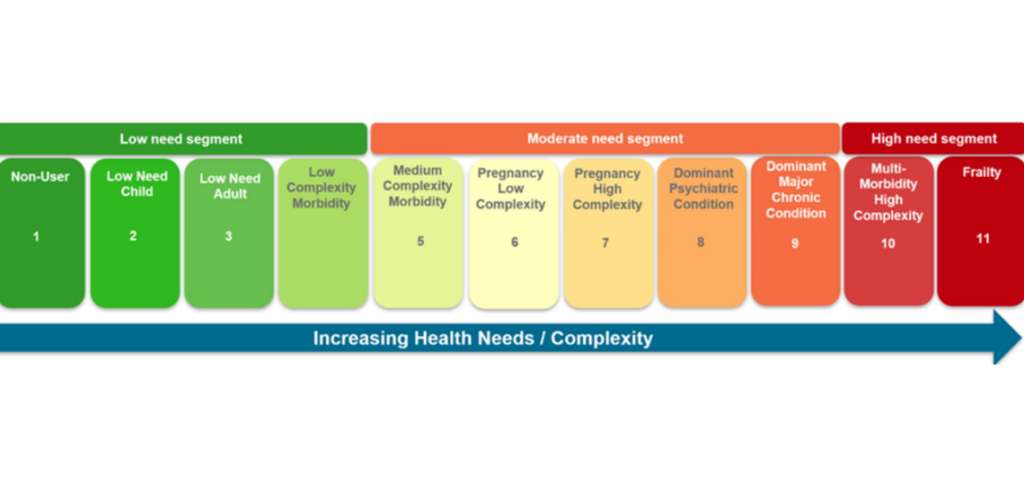
In Buckinghamshire, Oxfordshire and Berkshire West Integrated Care Board (BOB ICB) we use a well tested set of 11 segments/groups based on research by Johns Hopkins University. These are in the image above. Factors used for grouping include the number of conditions a person has and how severe those conditions are. This helps us decide what level of support that patients might need.
The categories break down into:
- Low need (PNG 1-4) (Green): Patients without significant health issues who need less intervention. Preventative care may stop them becoming unwell.
- Moderate need (PNG 5-9) (Orange): Patients who have a condition that is, generally, well managed. These patients may need occasional support to remain stable.
- High need (PNG 10-11) (Red): Patients who have several conditions. They may need regular monitoring or a more coordinated healthcare approach.
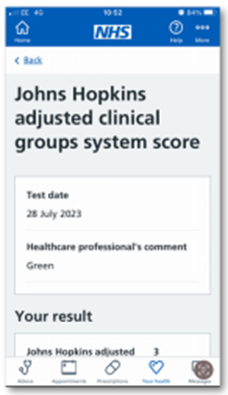
You may have seen this score in your NHS APP as “Johns Hopkins Adjusted Clinical Groups (ACG) system score” – see example (note the final implementation may be slightly different from that shown).
How do we do segmentation?
- Data Collection: The process begins with collecting data from various sources. In BOB, segmentation is part of the same platform as the TVS Care Record and uses the same data.
- Identifying Segments: The TVS Care Record platform runs the Johns Hopkins algorithm. This groups people into the 11 segments listed above. It uses information like what conditions a person has and how often they see a doctor.
- Analysis Tools. Health and care staff use tools to identify groups with different needs. We use the 11 segments plus other factors and expert input to determine which these groups are. We may do this for everyone in our area, a group of GP surgeries or within one GP surgery. In BOB, this uses the tools provided by the TVS Care Record platform.
- Intervention. We can use this analysis in one of three ways. (1) Provide active treatment to the selected group (e.g. inviting them for a blood pressure check up, etc.). (2) Change how we work for that group (e.g. longer appointments for more complex patients, etc.). (3) Change the services we provide (e.g. increasing the number of specialist nurses in certain clinical specialities, etc.).
What are the benefits of segmentation?
- Personalised Care. By understanding the needs of each group better, we can personalise care to those patients. This leads to improved health outcomes and patient satisfaction.
- Resource Allocation. By using the best treatment for each group it helps us make best use of our money and staff. It also means we can direct patients to the right place first time.
- Improved Health Outcomes. We can better identify those patients who need early interventions or tailored care plans. This leads to improved health outcomes, particularly for patients with chronic conditions.
- Preventative Care. We can identify patients who may need treatment before issues occur. By preventing complications, we can keep people healthier for longer.
Published on 22nd Apr 2026
Meningitis B (MenB) - Patient Information
We are aware of recent reports of Meningitis B (MenB), including cases in Kent. We understand this may be concerning; however, there is currently no impact in our local area. We will update patients if guidance changes.
Symptoms to be aware of:
- Fever, headache, vomiting
- Stiff neck, sensitivity to light
- Drowsiness or confusion
- Rash that does not fade when pressed
Babies may show different signs such as poor feeding, irritability or difficulty waking.
Vaccination Information
Who can have the MenB vaccine?
- Offered routinely on the NHS to babies at 8 weeks, 12 weeks and 1 year
- There is no NHS catch-up programme for older children or teenagers
What about teenagers?
- Teenagers are offered the MenACWY vaccine at school (protects against A, C, W and Y strains)
- This does not cover MenB, but remains important for protection against other strains and reducing transmission.
What should I do?
If you are concerned about symptoms, please contact the practice to speak to a clinician. For urgent concerns, contact NHS 111 or 999 in an emergency.
For questions about your vaccination status, please check the NHS App. If your baby is due vaccinations, please contact the practice to arrange these as soon as possible.
Published on 22nd Apr 2026
Weight Loss Injections
The NHS has recently released the criteria for accessing weight loss injections via your GP surgery.
The first phase for patients eligible for Mounjaro on the NHS are only of those with a Body Mass Index (BMI) of 40 or above & with 4 of the 5 defined conditions listed below:
- Diagnosed hypertension
- Diagnosed sleep apnoea
- Diagnosed type 2 diabetes
- Diagnosed cardiovascular disease
- Diagnosed hypercholesterolemia
If you do not have a BMI of 40 or above & 4 of the 5 conditions, the surgery will not be able to prescribe you Mounjaro for weight loss.
We will be contacting our eligible patients directly to discuss further.
NHS England Guidance: www.england.nhs.uk/ourwork/prevention/obesity/medicines-for-obesity/weight-management-injections
Published on 22nd Apr 2026
Page created: 20 April 2026